
As part of the Sustaining Competitive Advantage core module, participants of the Executive On-Campus track of the MaastrichtMBA visited the headquarters of dsm-firmenich in Maastricht. The visit was an integral part of the educational week, where strategy, marketing and supply chain management are explored as interconnected drivers of long-term performance.
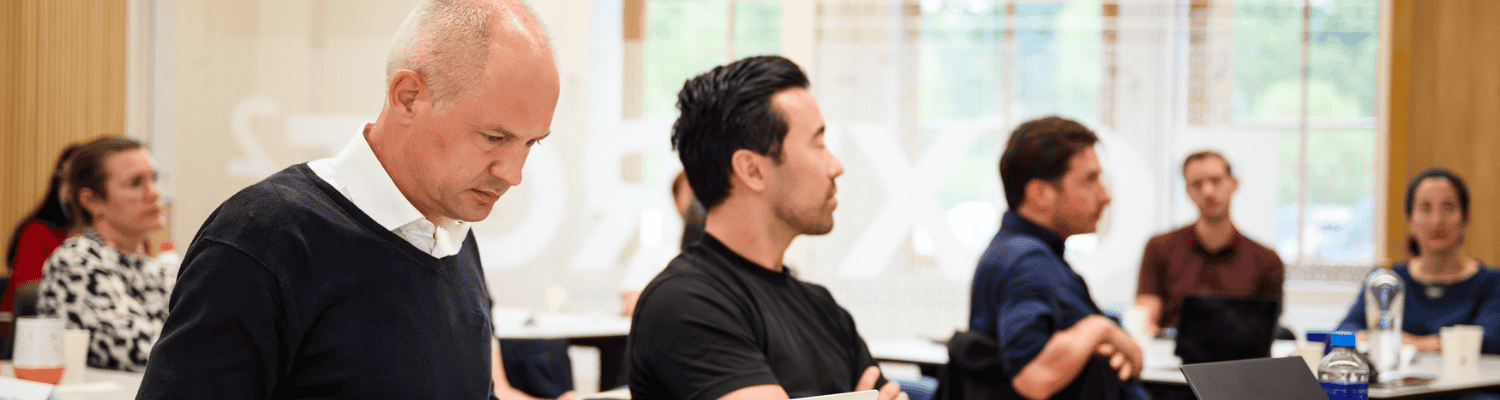
At dsm-firmenich’s newly established headquarters in Maastricht, students engaged with senior leaders and worked on a live business case that brought classroom theory vividly to life.
For many students, the visit began with a strong sense of arrival, not only at an impressive building, but at an organisation deeply anchored in its mission. Fernand de Vries, who started the Executive MBA in September 2025 and works as Manager SACM Data Management at ABN AMRO Bank, reflects: “DSM-Firmenich has just moved into a brand new, state-of-the-art head office in Maastricht. The most striking aspect was the atmosphere of purpose-driven science, where the company’s mission to solve global health and nutrition challenges is deeply integrated into its culture.”
The setting provided a fitting backdrop for discussions on how organisations sustain competitive advantage in fast-changing and complex environments.
The Sustaining Competitive Advantage module challenges students to reflect on five core strategic questions: from defining a winning aspiration to identifying the capabilities and systems required to execute successfully. The company visit offered a real-world setting to observe these principles in action.
Through a case provided by dsm-firmenich, students analysed how supply chain decisions and inventory levels directly influence profitability. Fernand explains: “By working on a case provided by dsm-firmenich, we gained insight into how supply chain design and inventory levels influence profitability. The visit clearly demonstrated how strategic choices translate into operational and financial outcomes.”
The company’s own transformation journey provided an even broader strategic lesson. Originating as a Dutch state-owned coal mining company, DSM has continuously reinvented itself, ultimately pivoting towards life sciences, nutrition and, following the merger with Firmenich, becoming a global leader in nutrition, health and beauty.
“Growing from a state-owned coal mining company into a global player in food ingredients and supplements is a mind-blowing pivot,” Fernand remarks. “It illustrates the power of continuously redefining your core business to remain competitive.”
A central theme throughout the visit was the integration of sustainability into core strategy. Not as a peripheral objective, but as a primary value driver. “The sessions revealed how dsm-firmenich places innovation and sustainability at the very core of its business strategy,” says Birgitta Nielsen, Director Global Commercial Operations at Quaker Houghton and participant since February 2025,. “Their approach is to align innovation with global trends such as preventative health and healthier diets, developing solutions that create a positive impact for both people and planet.”
Fernand similarly highlights that sustainability is embedded in decision-making processes: “Sustainability is not a separate goal at dsm-firmenich; it is one of the core drivers of innovation. Projects are evaluated not only on financial return, but also on their social and environmental impact.”
These insights resonated strongly with module discussions on balancing long-term capability development with short-term performance pressures, and on navigating the tensions inherent in strategy execution.
The visit also shed light on leadership approaches during large-scale transformation, particularly following the merger that created dsm-firmenich. Birgitta was inspired by the organisation’s clarity of direction: “I was impressed by how the organisation designed its strategy and roadmap, as well as its ‘seven traits’ leadership model for navigating change. The openness of the leadership team to receive candid feedback and actively engage with MBA students highlighted a transparent and inclusive culture.”
For Birgitta, who has experienced merger processes in her own organisation, the visit reinforced the critical importance of communication: “For me, a key takeaway is that effective change management and cross-functional collaboration are essential during major integrations. Success depends on a clear strategy, an actionable plan and, above all, robust communication. Communication is key.”
The competitive dynamics discussed during the visit further underlined the need for differentiation: “In today’s global marketplace, companies compete for the same customers,” Birgitta notes. “It is critical to clearly define, communicate and continuously strengthen your unique value proposition. If a business unit is not your core strength, you should not be afraid to divest. Otherwise, sooner or later, a competitor will outperform you.”
For both students, the visit reinforced the value of bridging academic frameworks and executive practice. “The visit inspired me to think differently about how companies can remain competitive in the long term by constantly adapting to a changing world, while maintaining a healthy balance between people, planet and profit,” says Fernand.
Birgitta agrees, and adds: “Company visits like this form a vital bridge between academic learning and practical business experience. Engaging directly with industry professionals allows us to interpret theoretical frameworks through real-world challenges. Even when you have faced similar situations yourself, there is tremendous value in seeing how another organisation approaches them.”
By stepping outside the classroom and into the boardroom, the Sustaining Competitive Advantage module clearly demonstrated its core ambition: equipping leaders not only to understand strategy, but to design, implement and sustain it in an increasingly complex world.
This article displays the student insights and experiences of our On-Campus MBA Sustaining Competitive Advantage module. Our On-Campus MBA track is part of the executive modular part-time MaastrichtMBA programme and next to that, we offer also an Online MBA learning format. The programme has a Triple Crown accreditation and is aimed for professionals with at least 5 years of working experience.